
Last Updated: August 2026
To replace your AC's air filter:
Locate the filter at the return vent or air handler.
Turn the system off.
Open the cover.
Slide out the old filter.
Clean the grille or slot before installing the new filter
Find the airflow direction
Insert the new filter and restore power
Most homes need this every 30-90 days — more often with pets, allergies, or heavy summer use.
Skill level: Simple · Time: 10-15 minutes · Cost: ~$10-$30 per filter
On this page:
Why It's Important
How Often Should You Change Your AC Filter?
Buy the Right Filter: Size and MERV
The 7 Steps
FAQs
Changing the air filter is the least expensive thing you can do to maintain your cooling system. And yet, it's the single most-skipped task in home HVAC care. That neglected filter quietly raises your energy bill, chokes your airflow, and shortens your air conditioner's life.
Why It's Important to Change Your Unit's Air Filter
Think of what a month of household dust looks like on your shelves. Now, imagine your AC breathing through it. Every bit of air your system moves passes through that one filter, and when it clogs, three things happen in sequence:
Diminished Air Flow and Air Quality
A saturated filter traps dust, mold spores, pollen, and allergens — then starts re-releasing them while starving the system of air. If anyone in your home deals with allergies or asthma, the filter is your first line of defense, and higher-efficiency filters (HEPA-grade where your system supports them) meaningfully improve what you breathe. For households that want cleaner air than any 1-inch filter can deliver, whole-home indoor air quality solutions take it further.
Short Cycling Can Occur
A choked filter makes the system overheat and shut down early, then restart, then repeat. It’s a pattern called short cycling that multiplies wear on the most expensive components and raises breakdown risk with every cycle. Left unaddressed, this is exactly the kind of strain that leads to a premature AC repair call.
Higher Energy Bills
A system dragging air through a clogged filter works harder for the same cooling. You pay for the effort. Routine monthly filter checks can trim meaningful percentage points off summer utility costs, while chronic neglect can shave 5-10 years off an air conditioner's lifespan. No other five-minute chore has that kind of return.
How Often Should You Change Your AC Filter?
You've heard 30 days, 60 days, 90 days — and the honest answer is that no single number fits every home. A better approach: know the warning signs, and know your household's factors.
4 Signs It's Time to Change the Filter Now
Dust accumulation. More dust on surfaces than usual means the filter is saturated and passing it through.
Poor cooling performance. Weak airflow at the vents or a house that takes longer to cool points to an obstructed filter.
Puddles or frozen coils. Dust reaching the evaporator coil makes it freeze; the melt-off leaves water pooling around the unit. If you see this, the filter is overdue and the system needs attention.
Elevated energy bills. An unexplained spike often correlates with longer runtimes behind a clogged filter.
Factors That Shorten the Interval
Change more often — every 30-45 days — if your household includes shedding pets, allergy or asthma sufferers, a smoker, a rural or farm setting, or nearby construction kicking dust into the air. A single-occupant home with no pets can often stretch toward 90 days.
First, Buy the Right Filter: Size and MERV
Finding your filter size
Every filter's size is printed on its cardboard frame: length × width × thickness, like 16x25x1, 20x20x1, or 20x25x1. Match it exactly; a filter that's close-but-not-quite lets unfiltered air bypass around the edges. No old filter to read? Measure the slot or the old filter yourself (round to the nearest standard size) and note that thicknesses run 1", 2", 4", and 5". Thicker media filters last longer and filter better, but only if your system is built for them.
One catch worth knowing: the size printed on a new filter's box is often a rounded 'nominal' size, not its exact physical dimensions — the actual filter may run about 1/4" to 1/2" smaller in each direction. That's normal and by design (it's what lets it seat properly in the track); don't re-measure a new filter and assume something's wrong if the numbers don't match perfectly.
Choosing a MERV rating
MERV (Minimum Efficiency Reporting Value) measures how fine a net the filter casts: higher numbers catch smaller particles but also resist airflow more:
MERV 6–8 | Solid basic filtration for most homes: dust, pollen, lint. The everyday choice. |
MERV 9–11 | Better capture of fine dust, pet dander, and mold spores: the allergy household's sweet spot. |
MERV 12–13 | Near-HEPA territory: smoke, bacteria, and the finest particles most residential systems can handle. Confirm your blower supports it before going this high. |
For most homes, MERV 8–13 is the right range. Go higher only if your system's documentation allows it, since an overly restrictive filter recreates the very clogged-filter problems you're trying to avoid.
Reusable vs. disposable
Some systems use washable, reusable filters (typically a sturdy plastic frame) instead of disposable cardboard-framed ones. If yours is reusable: vacuum off the heavy debris, rinse gently until the water runs clear, and let it dry completely before reinstalling, since a damp filter invites mold. If it's disposable, never wash it; replace it.
Not sure which you have? A cardboard frame means disposable, and the filter's label settles any doubt.
How to Change Your AC Filter: The 7 Steps
Locate your filter. Check the large return-air vent (usually a wall or ceiling grille) or the slot where the return duct meets the furnace/air handler. Consult your manual if it's hiding.
Turn off the AC unit. This stops the system from pulling loose debris into the works while the filter's out.
Pop open and remove the cover. Return grilles typically release with simple latches; slot covers slide or swing free.
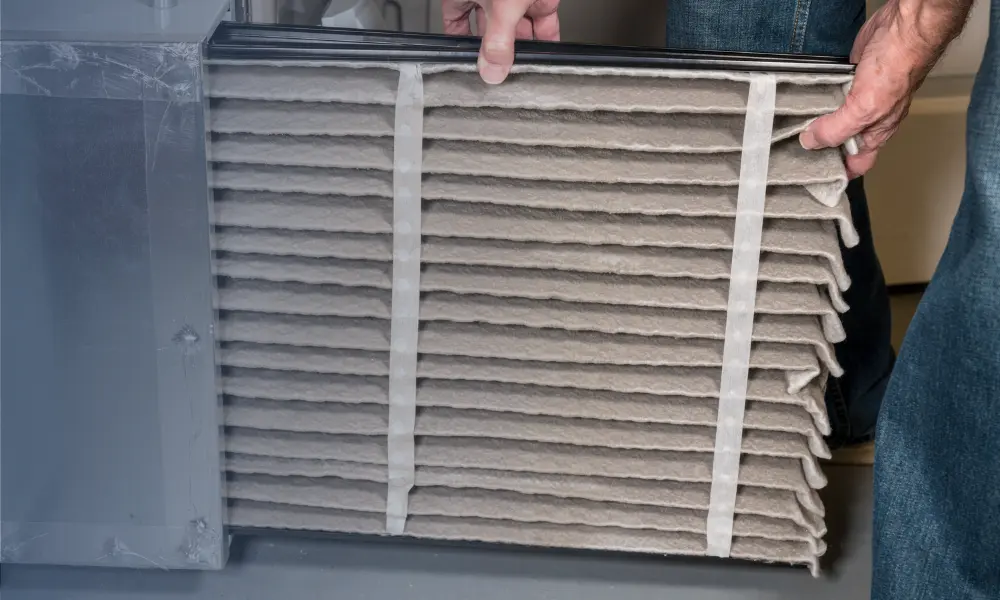
Take out the old filter. Give it the light test: hold it up to a light source. If you can see light through it clearly, it has life left; if it's gray, dense, and dark, it's done.
Clean the grille or slot before installing the new filter. A quick pass with a vacuum brush or damp cloth keeps loose dust from immediately dirtying the fresh filter.
Find the airflow direction. Every new filter has an arrow printed on its frame. That arrow must point in the direction the air flows, away from you and toward the unit/ductwork.
Insert the new filter and restore power. Seat it snugly in the track with no gaps at the edges — bypass air is unfiltered air. Close the cover, switch the system back on, and write the date on the frame before you walk away.
Hutchinson has kept South Jersey homes comfortable since 1948, and a seasonal AC check-up catches those whispers before they become August emergencies. Call 856-208-5993 and we'll get your air to a full bill of health.
Why Choose Hutchinson
Family-owned since 1948 — more than 75 years serving New Jersey, Pennsylvania, and Delaware — Hutchinson pairs "Always On-Time, Guaranteed" scheduling with upfront pricing, financing options, and a Comfort360 maintenance membership that makes filter checks, tune-ups, and priority service automatic.
If your system needs more than a filter, our service team and HVAC technicians handle everything from quick repairs to full replacements, with emergency service when summer doesn't wait. Call 856-208-5993 or book online today.
According to ENERGY STAR, a division of the EPA, dirt and neglect are among the top causes of cooling-system inefficiency and failure — one more reason this five-minute task is worth doing on schedule.
Changing your AC filter FAQs
How often should I replace my AC filter?
Replace your AC filter every 30-90 days for most homes. Lean toward 30-45 days if you have pets, allergies, a smoker in the house, or dusty surroundings. During heavy summer use, check monthly. Hold the filter to a light; if little light passes through, replace it.
Which way does the arrow on an AC filter face?
The arrow shows airflow direction, and air flows from your room toward the unit, so point the arrow away from the room, toward the ductwork or air handler. On a return grille, that means the arrow faces the wall or ceiling. Installing it backward makes the filter load up faster and work worse.
What MERV rating should I use at home?
MERV 8 suits most households; step up to MERV 11 for pets or allergies, and MERV 13 for the finest filtration most residential blowers can handle. Higher isn't automatically better. Too restrictive a filter chokes airflow like a dirty one. Check your system's documentation before going above 13.
Can a dirty air filter make my AC stop working?
Yes. A badly clogged filter restricts airflow until the evaporator coil freezes, the system short-cycles or overheats, and safety switches shut it down, sometimes with water pooling as the ice melts. If your AC quit and the filter looks like felt, replace it, let any ice thaw, and call a pro if it won't restart.
Is it cheaper to change the filter myself or have a pro do it?
A filter itself typically runs [$ RANGE], and changing it yourself takes about 10-15 minutes with no tools required — it's genuinely one of the best DIY-vs-pro tradeoffs in home HVAC care. Where a pro adds real value is catching problems a filter change alone won't fix, which is exactly what's included in a seasonal AC check-up.
Related Articles
What do you need help with today?
Heating
No heat, strange smells, rising bills? We repair and replace heating systems to keep your home reliably warm.
Air Conditioning
AC blowing warm air? Uneven cooling in your rooms? We fix cooling issues fast and keep your system running smoothly all summer.
Plumbing
Our highly trained plumbers handle it all, from leaky faucets to full system installations and repipes.
Electrical
The smartest team in town. You need repair, installations, wiring, inspections, lighting — you name it.